Invoice, receipt and tax invoice in Thailand: the difference
An invoice asks for payment, a receipt confirms you were paid, and a tax invoice can be issued only by a VAT-registered business. When each is issued, what it must show, and which ones a freelancer uses.
1In short: how the three differ
| Document | When | What it is for | Who may issue it |
|---|---|---|---|
| Invoice (ใบแจ้งหนี้) | Work delivered, not yet paid | States the amount and asks the client to pay | Any seller or service provider |
| Receipt (ใบเสร็จรับเงิน) | When you are paid | Confirms that you received the money | Anyone who receives the payment |
| Tax invoice (ใบกำกับภาษี) | When the VAT liability arises | Shows the VAT charged to the client | VAT-registered businesses only |
A freelancer who is not VAT-registered uses a quotation, an invoice and a receipt, and cannot issue a tax invoice.
2What an invoice is
An invoice (ใบแจ้งหนี้) is what a seller or service provider sends a client to ask for payment. It says what the work was, how much is due, by when, and how to pay.
- An invoice is not a receipt. It is issued before you are paid, so it cannot confirm payment.
- An invoice is not a tax invoice. Even from a VAT-registered business, it is a tax invoice only if it carries everything a tax invoice must show.
An invoice usually has both parties’ names and addresses, a document number, the date, the items, the total, the due date and how to pay. If the client is a company that withholds tax, state the amount you will actually receive: work it out with the withholding tax calculator, and add a PromptPay QR with the amount so the client can scan and pay.
3Invoice and billing note (ใบวางบิล)
In practice the two names are often used for the same thing: a request for payment. A billing note is generally used to collect several invoices into one request on the client’s payment cycle.
If a client’s accounts team asks for a "ใบวางบิล", ask whether it needs a separate document with that name or whether your invoice will do.
4What a receipt is
A receipt (ใบเสร็จรับเงิน) is the proof that you were paid. The Revenue Code calls it a "ใบรับ". Under Section 105 (in Thai), the person who receives the money must issue a receipt to the payer immediately, each time, when the amount received is above the figure set by the Director-General of the Revenue Department, whether or not the payer asks. The simple practice is to issue one every time you are paid.
Someone who receives payments in the ordinary course of business must keep a copy for at least five years, and the receipt must show at least the items in Section 105 bis:
- The issuer’s taxpayer ID
- The issuer’s name or trade name
- The serial number of the book and of the receipt
- The date of issue
- The amount received
- For a sale of goods priced at ฿100 or more: the type, name, quantity and price of the goods
Not issuing a receipt when you are paid, or issuing one for less than you received, is an offence under Section 127 bis.
If the client withholds tax, one more document belongs to that payment: the withholding tax certificate, which the client issues to you. See what the 50 Tawi is.
5What a tax invoice is
A tax invoice (ใบกำกับภาษี) belongs to the VAT system. Under Section 86 of the Revenue Code (in Thai), a VAT-registered business must issue one for every sale of goods or services, as soon as the VAT liability arises, and hand it to the buyer.
A full tax invoice must show at least the items in Section 86/4:
- The words "ใบกำกับภาษี" (tax invoice) in a clearly visible place
- The issuer’s name, address and taxpayer ID
- The buyer’s name and address
- The serial number of the tax invoice
- The name, type, quantity and value of the goods or services
- The amount of VAT, shown separately from the value of the goods or services
- The date of issue
- Any other wording the Director-General requires
A VAT-registered client asks for a tax invoice because, as a rule, it is the evidence for the input VAT of its business.
6Can you issue a tax invoice without VAT registration
No. Section 86/13 forbids anyone who is not a VAT-registered business from issuing a tax invoice. A person who issues one without the right to is liable for the VAT shown on it, as if registered.
- Do not use the words "tax invoice" or "ใบกำกับภาษี" on your documents, and do not add 7% VAT to an invoice or a receipt.
- When a client asks for a tax invoice, say that you are not VAT-registered and give a receipt. There is a message you can use in which documents you can issue without VAT registration.
- A business with income from sales or services of no more than ฿1.8 million a year does not have to register for VAT (Revenue Department, in Thai). If your income is near or above that figure, ask the Revenue Department or an accountant about registering.
7Receipt and tax invoice on one document
A document headed "ใบเสร็จรับเงิน/ใบกำกับภาษี" (receipt/tax invoice) comes from a VAT-registered business. Section 105 lets a registered business treat a tax invoice that states the money was received as the receipt, so the two are combined.
Someone who is not VAT-registered issues a receipt only.
8The documents for one job
Example: a ฿15,000 design job for a company client, by a freelancer who is not VAT-registered.
- Quotation, before the work: the scope and the ฿15,000 price, for the client to accept.
- Invoice, on delivery: asks for ฿15,000 and states that the client withholds 3%, which is ฿450, leaving ฿14,550 to transfer.
- Receipt, when the money arrives: confirms that you were paid.
- 50 Tawi, from the client: the proof of the ฿450 withheld. The client issues this one.
9Making all three with BaiPe
BaiPe makes quotations, invoices and receipts on your phone, and turns one into the next in one tap with nothing typed again. The documents carry no VAT, and BaiPe does not issue tax invoices.
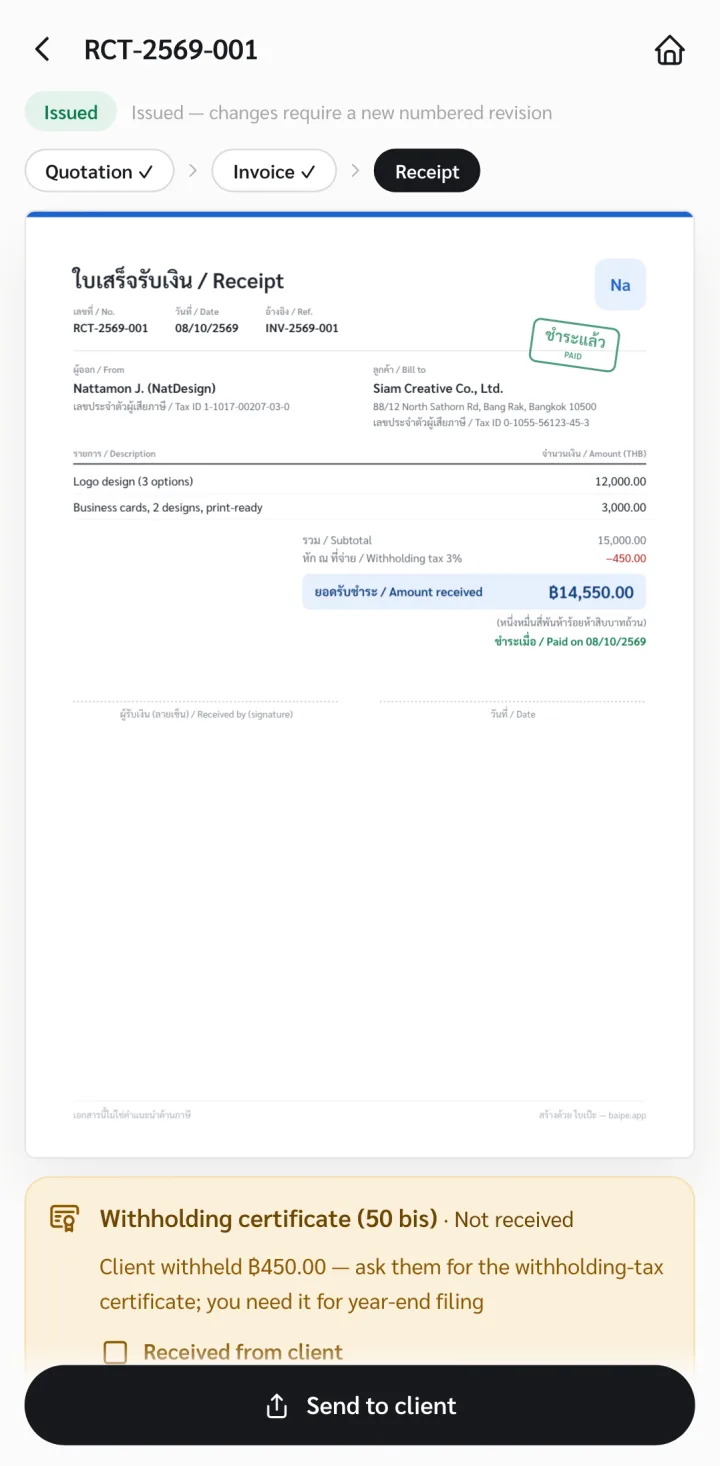
Your first 3 documents are free, with no signup. Start at app.baipe.app or read how to make an invoice on your phone.
10Common questions
What is the difference between an invoice and a receipt?
An invoice is issued before payment, to ask the client to pay. A receipt is issued once you are paid, to confirm it.
Can an invoice be used as a receipt?
No. An invoice says an amount is due, not that it was paid. When you are paid, issue a receipt as well.
Is an invoice a tax invoice in Thailand?
No. Only a VAT-registered business may issue a tax invoice, and it must show the items in Section 86/4, such as the words "ใบกำกับภาษี" and the VAT amount shown separately.
Are a receipt and a tax invoice the same?
No. A receipt confirms payment and anyone who is paid can issue one. A tax invoice shows the VAT charged and only a VAT-registered business can issue it, though such a business may combine the two on one document.
Can I issue a receipt if I am not VAT-registered?
Yes. A receipt has nothing to do with VAT registration. Whoever receives the money can issue it, with no VAT added.
Can I issue a tax invoice if I am not VAT-registered?
No. Section 86/13 of the Revenue Code forbids it, and a person who issues one without the right to is liable for the VAT shown on it.
Can an individual issue an invoice and a receipt?
Yes. You do not need a company. Put your name, address and 13-digit taxpayer ID on the document.
11Sources
The rules on this page come from these Revenue Department documents (in Thai), last checked against the originals on 8 October 2026.
- Revenue Code, Sections 86, 86/4 and 86/13: the duty to issue a tax invoice, what it must show, and who may not issue one
- Revenue Code, Section 105: the duty to issue a receipt, and a tax invoice that serves as the receipt
- Revenue Code, Section 105 bis: what a receipt must show, and keeping a copy for five years
- Revenue Code, Section 127 bis: the penalty for not issuing a receipt
- Revenue Department: businesses that do not have to register for VAT: income of no more than ฿1.8 million a year