Receipt example for individuals and freelancers in Thailand
A receipt (ใบเสร็จรับเงิน) is the proof that a client paid you. A freelancer or individual issues one when the money is received. This page shows a filled-in one for a ฿15,000 job with 3% tax withheld, what each part is for, and which parts the law requires.
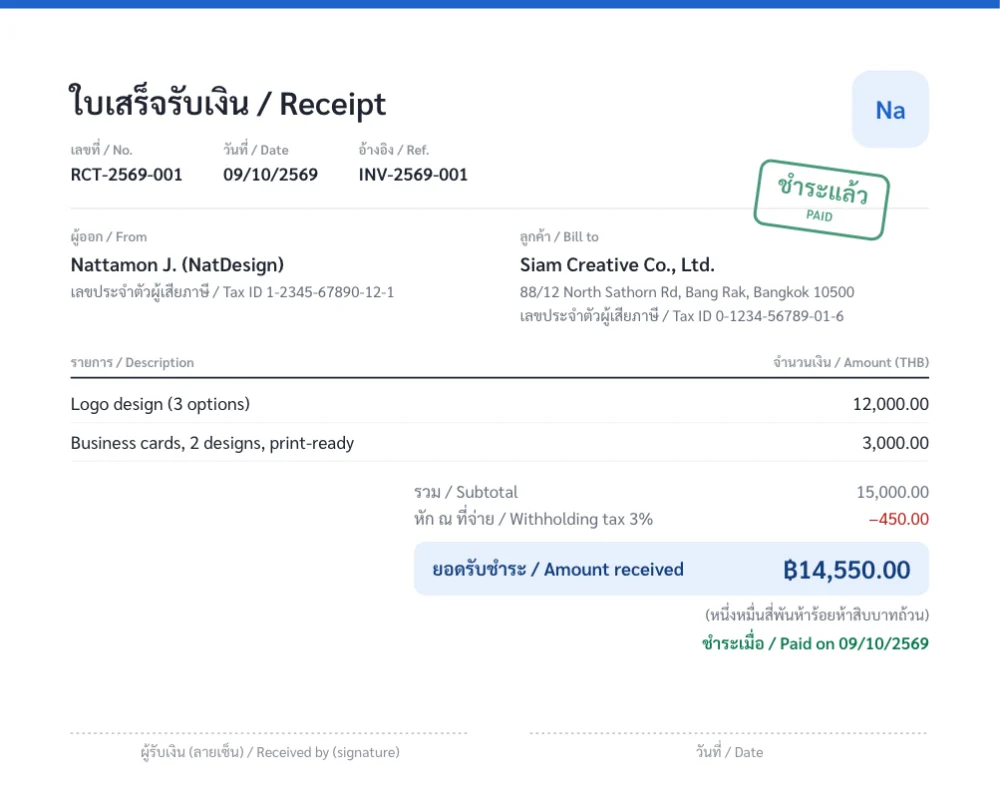
What is on it
- The number, date and the invoice it refers to
- The issuer’s name and taxpayer ID: the person who was paid
- The client’s name, address and taxpayer ID
- Each item of work and its price
- Subtotal, 3% withholding tax and amount received
- The date paid, a "PAID" stamp and a line for the payee’s signature
Your first 3 documents are free, with no signup. Made on your phone; you get a PDF to send in a chat.
1When to issue a receipt
Issue it once you have been paid, so the client has proof of payment. The Revenue Code calls a receipt a "ใบรับ". The duty to issue one is in Section 105 and the penalty for not issuing one is in Section 127 bis (both in Thai). Both are explained in invoice vs receipt vs tax invoice.
The one in the example was made from the example invoice, INV-2569-001, after the client paid, so its items and amounts match the invoice. All three example documents were made on one day, which is why they carry the same date. On a real job each carries the day it was issued.
2What a receipt must include
Unlike a quotation or an invoice, what a receipt shows is set by law. The receipt must show at least the items in Section 105 bis (in Thai):
- The issuer’s taxpayer ID
- The issuer’s name or trade name
- The serial number of the book and of the receipt
- The date of issue
- The amount received
- For a sale of goods priced at ฿100 or more: the type, name, quantity and price of the goods
This page shows where each item is on the example. It does not confirm that your own receipt meets the law in every case, for example a running document number with no book number, or which amount to show when tax was withheld. If you are not sure, ask the Revenue Department (call 1161) or an accountant.
3Each part of the example receipt
From top to bottom of the example above. Parts marked "Section 105 bis" are the items in the section before this one. The rest is trade practice.
| Part | In the example | Why it is there |
|---|---|---|
| Heading | ใบเสร็จรับเงิน / Receipt | Says the document is proof of payment |
| Number | RCT-2569-001 | Section 105 bis: the serial number of the receipt |
| Date | 09/10/2569 | Section 105 bis: the date of issue |
| Ref. | INV-2569-001 | The invoice the client paid, which its accounts team uses to match the documents |
| Issuer | Name and 13-digit taxpayer ID | Section 105 bis: the issuer’s name and taxpayer ID |
| Client | Company name, address, taxpayer ID | Says who the money came from |
| Items | Logo design 12,000.00, business cards 3,000.00 | Says what the money was for |
| Subtotal | 15,000.00 | The price of all the work |
| Withholding tax 3% | −450.00 | What the client kept back and did not transfer to you |
| Amount received | ฿14,550.00, also written out in Thai | Section 105 bis: the amount received. The example shows what reached the account, next to the subtotal and the tax withheld |
| Paid on | 09/10/2569 | The day the money was received |
| "ชำระแล้ว / PAID" stamp | Top right of the page | Shows at a glance that this one is paid |
| Received by (signature) and date | Two dotted lines at the bottom | A place to sign, for a client that asks for a signed receipt |
The year 2569 is the Buddhist-era year, which Thai documents commonly use. A receipt has no PromptPay QR, because it is already paid, and the example has no VAT line because the issuer is not VAT-registered.
4How the amounts on the receipt are worked out
The job in the example is priced at ฿15,000. The client is a company and withheld 3% tax (as a rule, on service fees, under Revenue Department Order Tor Por 4/2528, in Thai), so ฿14,550 reached the account.
| Line on the document | How it is worked out | Amount (THB) |
|---|---|---|
| Logo design (3 options) | The agreed price | 12,000.00 |
| Business cards, 2 designs, print-ready | The agreed price | 3,000.00 |
| Subtotal | 12,000 + 3,000 | 15,000.00 |
| Withholding tax 3% | 15,000 × 3% | −450.00 |
| Amount received | 15,000 − 450 | 14,550.00 |
BaiPe works out withholding tax once, on the document’s subtotal, and rounds a fraction of a satang half up. This example has no fraction.
- The proof of the ฿450 withheld is the withholding tax certificate, which the client issues to you. See what the 50 Tawi is.
- Work out the figure for your own job with the withholding tax calculator.
- If the client did not withhold tax, the amount received equals the subtotal.
5A receipt from an individual
An individual or freelancer can issue a receipt. You do not need a company.
- Use your own name (with a trading name after it if you like) and your 13-digit taxpayer ID.
- If you are not VAT-registered, add no 7% VAT and do not head the document "ใบเสร็จรับเงิน/ใบกำกับภาษี" (receipt/tax invoice). See which documents you can issue without VAT registration.
- Someone who receives payments in the ordinary course of business must keep a copy for at least five years (Section 105 bis, in Thai).
6What a receipt is not
- Not an invoice. An invoice goes out before you are paid, to ask for payment: see the invoice example.
- Not a tax invoice. A person who is not VAT-registered may not issue one, under Section 86/13 of the Revenue Code (in Thai).
- Not a 50 Tawi. The withholding tax certificate is a document the client issues to you.
For how the documents differ, see invoice vs receipt vs tax invoice. For what to say when a client asks for a tax invoice, see which documents you can issue without VAT registration.
7Making a receipt like this on your phone
The example was made with the BaiPe app. It runs in your phone’s browser, with nothing to install and no signup. Once you record the payment on the invoice, tap "Issue receipt" and the items and amounts carry over from the invoice with nothing typed again.
Your first 3 documents are free. After that a one-time ฿249 gives unlimited documents and your logo and signature. This page offers no Excel or Word file to download and no blank form to print. For the steps with pictures, see how to make a quotation, invoice and receipt on your phone.
8Common questions
What must a receipt from an individual show in Thailand?
Under Section 105 bis of the Revenue Code a receipt must show at least the issuer’s taxpayer ID and name, the serial number of the book and of the receipt, the date of issue, the amount received, and the goods when goods priced at ฿100 or more are sold.
Which amount goes on the receipt when tax was withheld?
The example shows all three: the ฿15,000 subtotal, the ฿450 tax withheld and the ฿14,550 received. If the client’s accounts team wants another layout, ask the client or an accountant.
Does a receipt need a signature?
A signature is not among the Section 105 bis items listed on this page, but some clients’ accounts teams ask for a signed receipt. The example has a line for the payee’s signature.
Can I put my logo and signature on the receipt?
Yes. In BaiPe, a logo and a signature on your documents are part of the one-time ฿249 version.
Is there an Excel or Word receipt template to download?
No. This page is an example with an explanation. To get a document like it, make one in the BaiPe app and you get a PDF; the first 3 are free.
Can I make a receipt in English?
BaiPe documents have headings in both Thai and English, as in the example. You can type the names and items in any language.
9Sources
The rules on this page come from these Revenue Department documents (in Thai), last checked against the originals on 8 October 2026.
- Revenue Code, Section 105: the duty to issue a receipt
- Revenue Code, Section 105 bis: what a receipt must show, and keeping a copy for five years
- Revenue Code, Section 127 bis: the penalty for not issuing a receipt
- Revenue Department Order Tor Por 4/2528: 3% withholding on service fees by payers that are juristic persons
- Revenue Code, Section 50 bis: the payer issues the withholding tax certificate
- Revenue Code, Section 86/13: a person who is not VAT-registered may not issue a tax invoice